Water compliance testing for dental practices

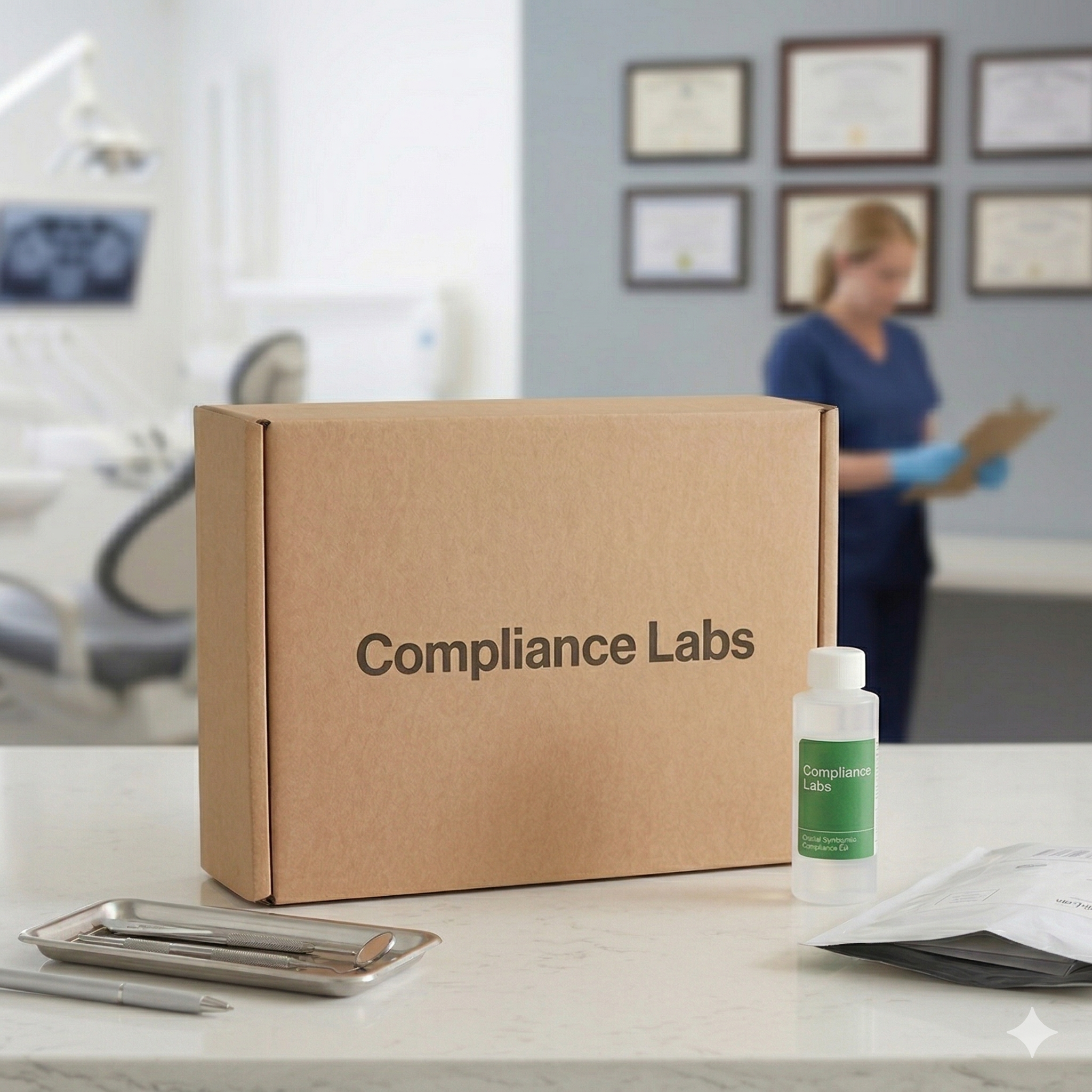
Dental practices have two separate water testing obligations. We cover both — chair water and sterilisation room — with NATA-accredited results and zero admin on your end.
Your Compliance Obligations

Two water systems. Two seperate requirements.

Obligation 1 Chair Water Testing ADA IPC Guidelines (5th Ed.) · Dental Board of Australia
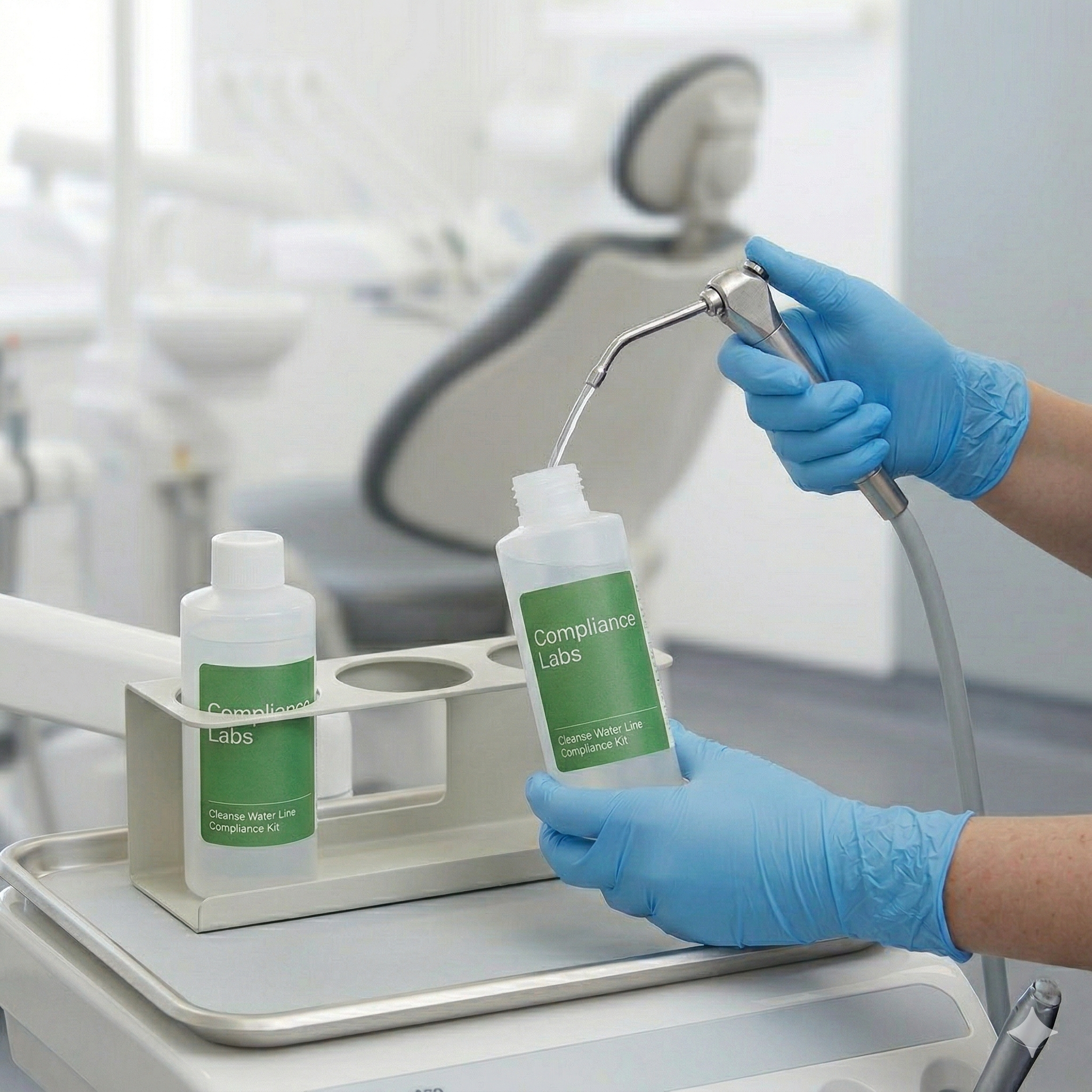
The water flowing through your dental chairs — into handpieces, ultrasonic scalers and air/water syringes — passes through narrow tubing that can harbour bacterial biofilm. Testing confirms bacteria levels are within safe limits for patient care.
Frequency Quarterly
Limit < 200 CFU/mL
The purified water in your sterilisation room must meet strict chemistry and microbiology limits. This covers both your washer-disinfector final rinse water (Table 7.2) and your autoclave feedwater (Table 7.4), and applies to all practices that reprocess reusable instruments.

Products and Pricing

Everything your practice needs. Sample kit, courier and accredited report Included.

All prices ex GST · Kit, courier and NATA-accredited report included
Required — Quarterly SWL-D
Chair Water Test ADA IPC Guidelines (5th Ed.) · Dental Board of Australia
$499 4 chairs
ex GST · per quarterly round

During treatment, water flows through narrow tubing inside every dental chair — into handpieces, scalers and syringes. Bacteria builds up in these lines over time. Testing confirms bacteria levels are within safe limits for patient care.
How many dental chairs?
Each chair requires its own sample — results reported per chair.
HCC by R2A agar, 25°C, 7-day incubation
One sample per chair — each chair is a separate circuit
Benchmarked against ADA limit of <200 CFU/mL
NATA-accredited Certificate of Analysis + audit-ready compliance report
Order now → Select your chair count on the product page to confirm your price.
Required — Monthly SWL-R
Monthly Sterilisation Room Test AS 5369:2023 Table 8.1 · Routine Monitoring
$442 / month
ex GST · Year 1

AS 5369:2023 requires monthly testing of the water in your sterilisation room. Routine monitoring confirms bacteria levels and key chemistry parameters are within specification every month.
Conductivity, hardness and chloride
Total Viable Count (TVC) by R2A membrane filtration — Year 1
One sample covers your whole practice
NATA-accredited Certificate of Analysis
Year 2+ $333/ mo
After 12 months of consistently passing results, AS 5369:2023 allows TVC testing to drop from monthly to annual. Year 2 kits cover chemistry only — conductivity, hardness and chloride.
Order now → Kit dispatched within one business day of order.
Required — Annual SWL-W
Washer-Disinfector Annual Audit AS 5369:2023 Table 7.2 · Final Rinse Water
$949 ex GST
per annual submission

Once a year, AS 5369:2023 requires a full parameter screen of your washer-disinfector final rinse water. This goes beyond the monthly routine test to include endotoxins, iron, phosphates and silica.
pH, conductivity, hardness, chloride
Iron, reactive phosphates, reactive silica
Total Viable Count (TVC)
Bacterial Endotoxins (LAL) — ≤0.25 EU/mL
Reported against all AS 5369:2023 Table 7.2 limits
NATA-accredited Certificate of Analysis
Note: Also required when a new washer-disinfector or RO filter is installed. If your washer and autoclave share a water supply, see the Combined Audit below.
Order now → Kit dispatched within one business day of order.
Required — Annual SWL-A
Autoclave Feedwater Test AS 5369:2023 Table 7.4 · Autoclave Feedwater
$795 ex GST
per annual submission

Your autoclave requires chemically pure feedwater to function correctly and protect instruments. AS 5369:2023 Table 7.4 sets strict chemistry and metals limits for dedicated steam generator feedwater.
pH, conductivity, hardness, chloride (strict limits)
Evaporative residue (Total Solids)
Reactive silica and phosphates
Full heavy metals screen — Cd, Pb, As, Hg + others
Colour and appearance
NATA-accredited Certificate of Analysis
Note: Applies to dedicated steam generator autoclaves. Also required at new autoclave installation (IQ/OQ). If your washer and autoclave share a water supply, see the Combined Audit below.
Order now → Kit dispatched within one business day of order.

How It Works

  • Safe Water Lab Kit

    Step 1 - We send you a kit

    A sample kit is sent to your business. Everything you need is included.

  • Illustration of a woman cleaning a kitchen countertop with cleaning spray, near the sink, with various cleaning supplies on the counter.

    Step 2 - Collect the sample

    The process takes about 5 minutes. Step-by-step instructions included. Your practice manager or dental assistant can do this.

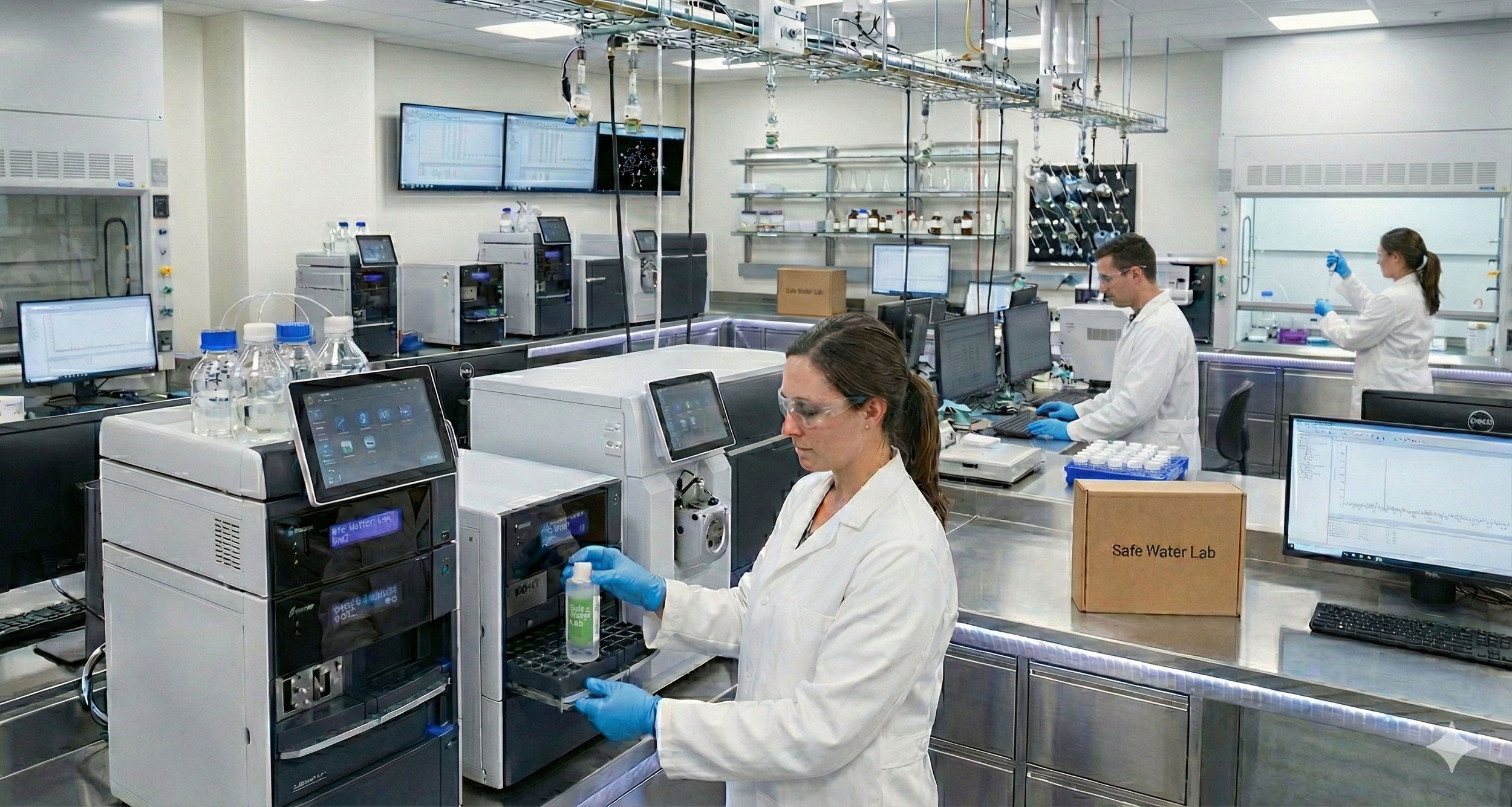
  • Two scientists in a laboratory, one male and one female, working at a table with large glass flasks filled with blue liquid, surrounded by lab equipment and shelves with chemicals, with a clock showing 2:15.

    Step 3 - Priority pick up

    Call the priority number in your kit, quote your pre-paid barcode, and a courier collects directly from your reception desk — no accounts, no paperwork, no cost to you.

  • Safe Water Lab Report

    Step 4 - Receive your results

    Your NATA Certificate of Analysis and audit-ready compliance report are emailed within 5–7 business days — benchmarked against AS 5369:2023 and ADA guideline limits, ready to file for your next audit.

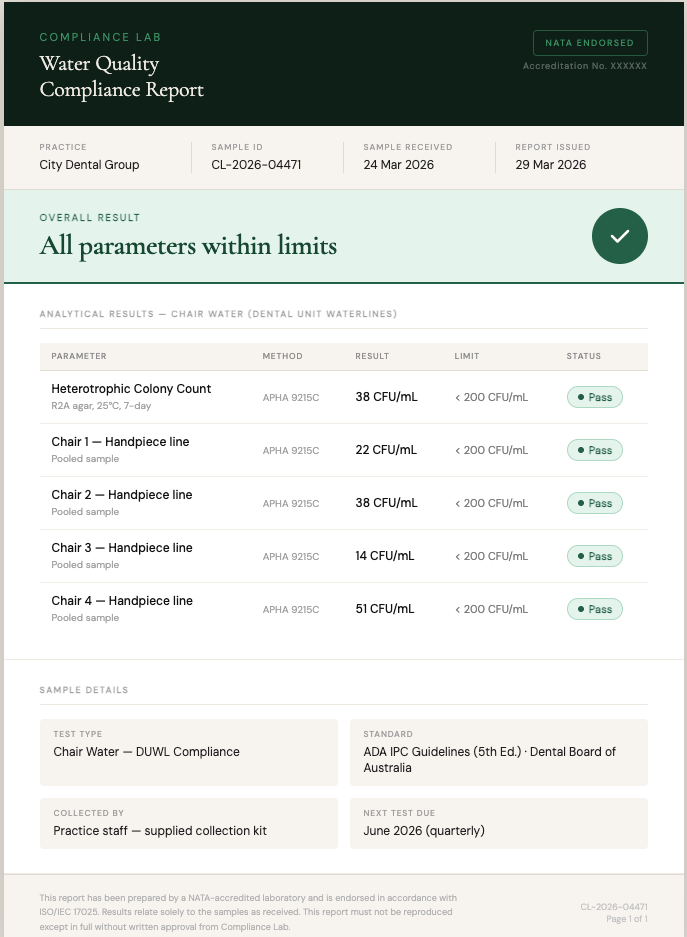
Your compliance report, clearly explained

Every test includes a NATA-endorsed Certificate of Analysis and an audit-ready compliance report. Your report shows each parameter, the result, the regulatory limit, and whether it is within specification. Everything you need to file for your compliance records.

  • Issued by a NATA-accredited laboratory under ISO/IEC 17025

  • Results benchmarked against ADA Guidelines and AS 5369:2023 limits

  • NATA accreditation under ISO/IEC 17025 is the recognised standard for documentary evidence in any Dental Board of Australia or AHPRA audit or accreditation review

  • Emailed within 5–7 business days of sample receipt

  • NATA Certificate of Analysis attached as PDF — ready to file

Example report uses fictitious practice and sample data.
Compliance Labs Water Quality
Compliance Report
NATA Endorsed
PracticeCity Dental Group
Sample IDCL-2026-07832
Received24 Mar 2026
Issued29 Mar 2026
Standard AS 5369:2023 Table 7.2 — Final Rinse Water (Washer-Disinfector)
Overall result All parameters within limits
Chemistry
Parameter Result Limit Status
pH 6.4 5.0–7.0 Within limits
Conductivity 18 µS/cm ≤30 µS/cm Within limits
Total Hardness <1 mg/L ≤2 mg/L Within limits
Chloride 8.2 mg/L ≤50 mg/L Within limits
Reactive Phosphate 0.08 mg/L ≤0.3 mg/L Within limits
Silica (Reactive) 0.12 mg/L ≤1.0 mg/L Within limits
Iron (total) <0.02 mg/L ≤0.2 mg/L Within limits
Microbiology
Parameter Result Limit Status
Bacterial EndotoxinsLAL kinetic-chromogenic 0.04 EU/mL ≤0.25 EU/mL Within limits
Heterotrophic Colony CountR2A agar, membrane filtration <1 CFU/100mL ≤100 CFU/100mL Within limits
Prepared by a NATA-accredited laboratory in accordance with ISO/IEC 17025. Results relate solely to the samples as received. This report must not be reproduced except in full without written approval from Compliance Labs. CL-2026-07832
Page 1 of 1

Common Questions

Yes — they are completely separate water systems with separate compliance obligations. The water flowing through your dental chairs has nothing to do with the water in your sterilisation room. Chair water is governed by the ADA IPC Guidelines, while sterilisation room water is governed by AS 5369:2023. Both are mandatory.
Yes. Collection takes around 5 minutes and requires no specialist training. Clear step-by-step instructions are included in every kit. Your practice manager or dental assistant can do this during any quiet moment in the day. No lab visit required.
The monthly test covers routine monitoring — bacteria levels and key chemistry parameters checked every month to confirm your system is within specification. The annual audit is a more comprehensive screen covering all AS 5369:2023 Table 7.2 parameters, including endotoxins, iron, phosphates and silica. Both are required under AS 5369:2023 — they complement each other rather than one replacing the other.
It depends on your setup. If your washer-disinfector and autoclave are connected to the same RO water outlet, one sample covers both — use the Combined Sterilisation Room Audit and save $495 compared to testing separately. If they have separate water supplies, you need both tests individually. Not sure which applies to your practice? Contact us and we’ll help you work it out before you order.
The ADA IPC Guidelines (5th Ed.) recommend quarterly testing for established practices. For new practices, or following a failed result, monthly testing is recommended until two consecutive passing results are achieved. Quarterly testing should then resume and be maintained as your ongoing compliance baseline.
A failed result isn’t unusual — particularly on a first test. We’ll notify you immediately and explain clearly which parameter failed and by how much. Most failures are resolved by flushing the water system and retesting. We offer a post-fail retest kit to get your practice back into compliance quickly, with a new NATA-accredited result to file.
DIY dipslide test kits can give a rough pass/fail indication but they are not NATA-accredited and do not produce a Certificate of Analysis. If your practice is subject to an infection control inspection by the Dental Council, or if a patient complaint leads to an AHPRA investigation, a DIY result will not provide the documented, independent evidence you need. A NATA-accredited result from an ISO/IEC 17025 accredited laboratory is the standard of documentation that regulators, insurers and courts recognise.
Yes. Our laboratory partners hold NATA accreditation under ISO/IEC 17025 — the accreditation standard recognised by the Australian Government and accepted by the Dental Board of Australia, AHPRA and the courts. Each result comes with a NATA-endorsed Certificate of Analysis ready to file for your compliance records.
Yes. Waterline treatment products reduce bacterial growth but do not guarantee compliance — treated lines still fail testing in a significant proportion of practices. The ADA IPC Guidelines and AS 5369:2023 both require documented testing regardless of the treatment protocol in place. Testing is the only way to confirm that your treatment is actually working and to produce the compliance record your practice needs.
Your NATA Certificate of Analysis and plain-English results summary are emailed within 5–7 business days of the laboratory receiving your sample. HCC testing by R2A agar requires a 7-day incubation period — this is the gold standard method required by the ADA Guidelines and cannot be shortened without compromising accuracy.
Testing is not framed as a direct statute but the compliance obligation is real. Every dentist affirms IPC compliance at AHPRA registration renewal. The DBA expects practitioners to follow the ADA IPC Guidelines, which reference AS 5369:2023. Practices without documented testing results are exposed — during an infection control inspection, a patient complaint, or an AHPRA investigation, the absence of testing records is a gap that cannot be explained away.